
The $100 Vanity Mistake: Why 7 Coats of Finish Matter in a Humid Bathroom
A cheaper vanity can look identical on day one. In a humid bathroom, a thin 2-3 coat finish fails at the joints, and saving $100 now can cost $600 or more later. Here is what 7 coats of 2K polyurethane changes, and how to check any vanity before you buy.

A cheaper vanity can look almost identical to a well-built one on the showroom floor. The difference shows up later, in the steam of your bathroom, one shower at a time. Here is what we have learned after more than 10 years and 10,000+ customers in Metro Atlanta.
The vanity that looked fine on day one
We hear the same story more often than we would like. Someone buys a vanity online or from a big-box aisle because it was about $100 less. It looks great when it goes in. A year or two later, the paint at the bottom of the legs starts to lift. A hairline crack opens along a joint. The edge of a door gets soft and swollen. By year three or four, the cabinet looks tired, and in the worst cases the wood underneath has started to swell and come apart.
None of that is bad luck. It is the finish. And the finish is the one thing you cannot judge from a product photo.
What a bathroom does to a cabinet
A bathroom is the hardest room in the house on furniture. Every hot shower pushes the air close to 100% humidity. Steam settles on every surface, then dries, then comes back the next morning. Add splashes from the sink, wet towels, and cleaning sprays, and your vanity goes through hundreds of wet and dry cycles every year.
Wood and wood-based panels take on moisture and release it. When they do, they swell and shrink. The only thing standing between your cabinet and that moisture is the finish. If the finish is thin, brittle, or has gaps at the joints, water finds the weak spot: the seams, the cut edges, the bottom of the legs, the inside of the doors. Once moisture gets under the paint, the damage only goes one direction.
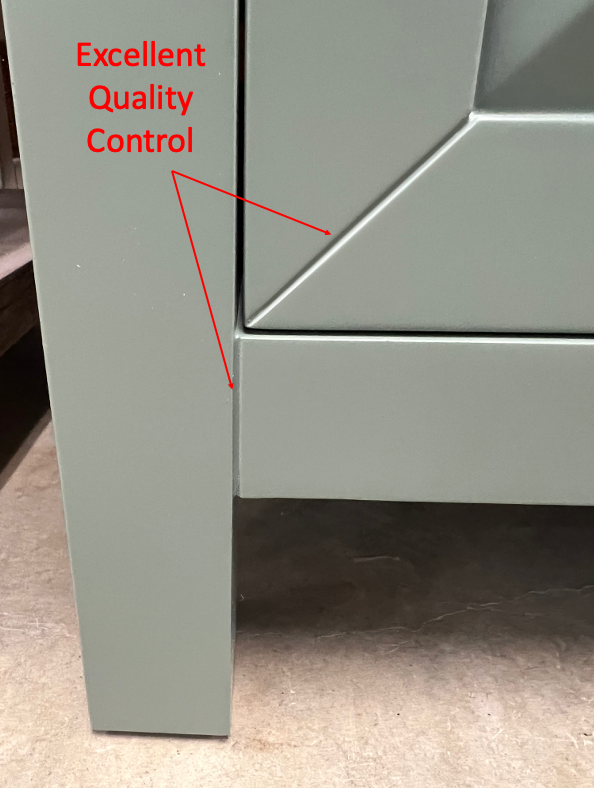 Ours: 7 coats, tight joints, clean edges |
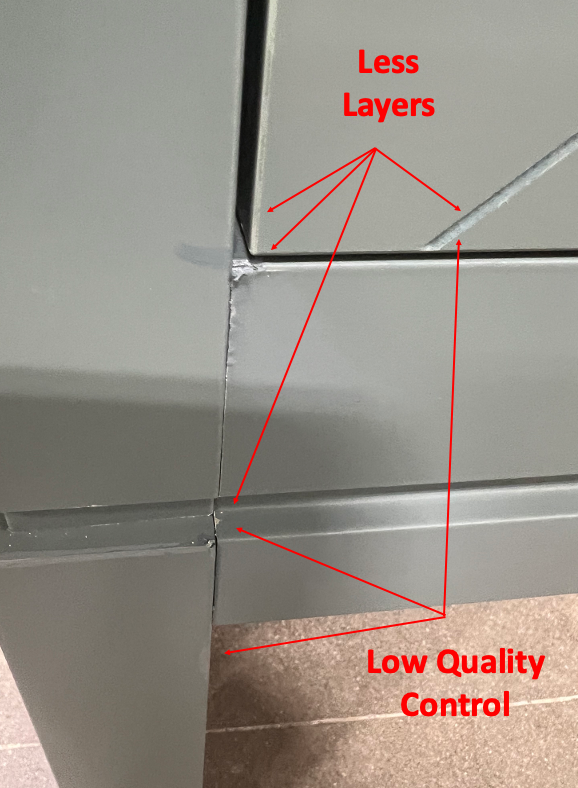 Typical: 2–3 coats, chipped edges, open seams |
Two very different finishes
Most of what separates a vanity that lasts from one that does not comes down to what is sprayed on it, and how many times.
Typical import vanity: 2–3 coats
- Nitrocellulose lacquer or a 1K (one-part) poly mix. These dry quickly and are cheap to apply, which is why they are common. They dry by evaporation, so they stay softer and more open to moisture over time.
- Only 2–3 coats. Thin coverage, especially on edges and corners, where the finish naturally pulls away.
- Minimal sanding. Rough spots and raised grain get painted over instead of fixed, so the finish sits on an uneven surface and cracks first at the joints.
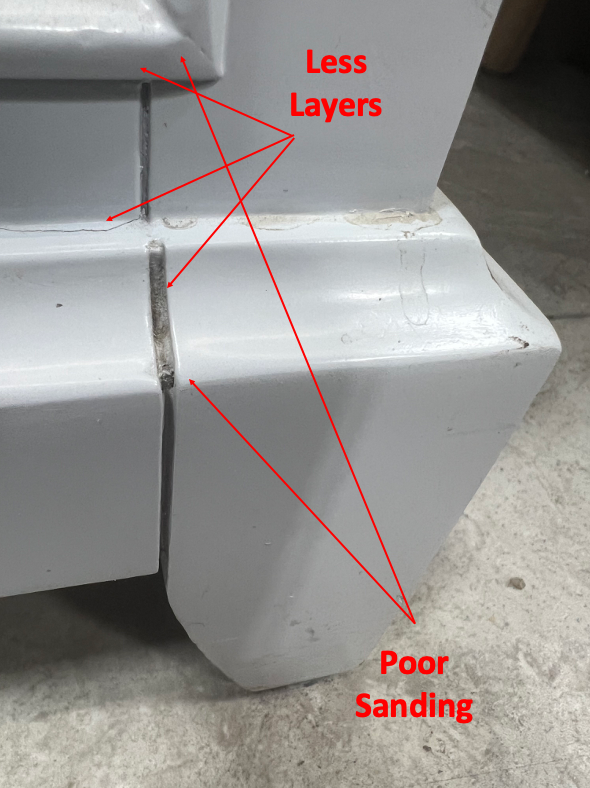 A gapped leg joint and rough, unsanded edges |
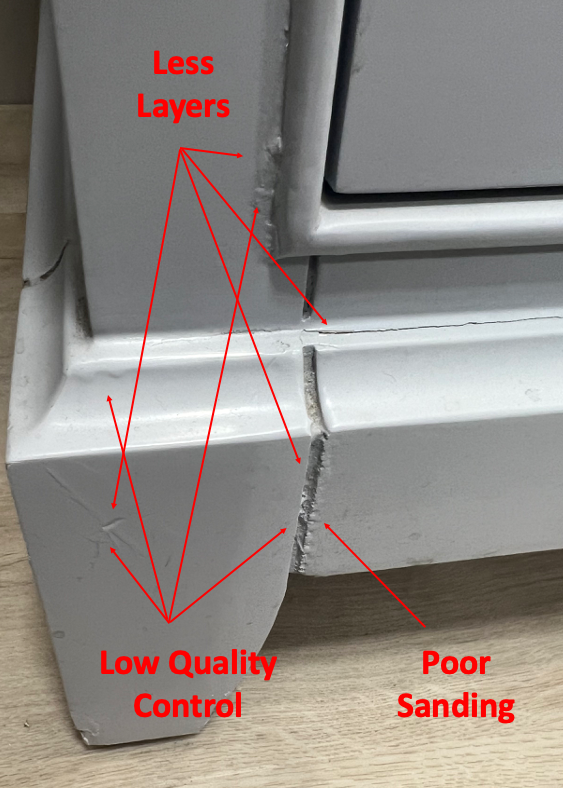 Thin finish already cracking along the seams |
Look closely at those seams. That is where water gets in first.
Our vanities: 7 coats of 2K polyurethane
- Low-VOC 2K (two-part) polyurethane with ceramic additives. A 2K finish is mixed with a hardener and cures chemically into a tough, sealed film. It is the same family of coating used where durability matters. The ceramic additives add scratch and wear resistance.
- 7 coats of PU paint, sanded between coats. Each layer is sanded smooth before the next goes on, so the finish bonds properly and builds into a thick, even, sealed shell, including on the edges and joints.
- Tight joinery and quality control. Seams are filled and sealed before finishing, not painted over and hoped for the best.
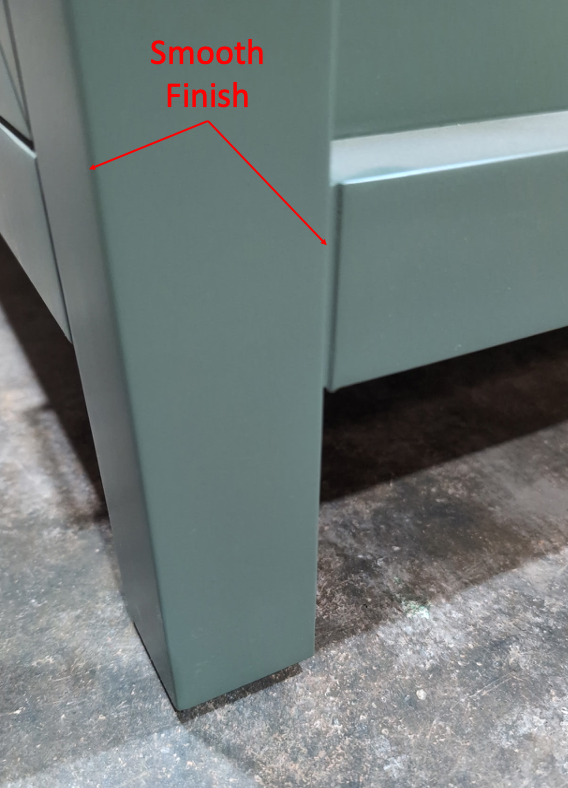 Smooth, even finish all the way down the leg |
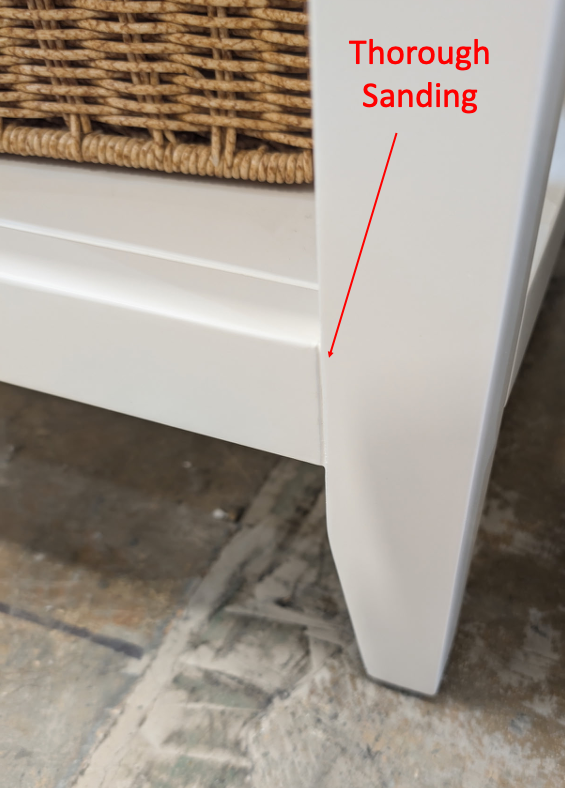 Thorough sanding leaves a clean, crisp edge |
What happens over time
In a busy family bathroom, this is the pattern we see most with thin, low-coat finishes:
- The first year: It looks fine. Maybe a small chip near the toe kick from a vacuum or a foot.
- Years 2–3: Hairline cracks at the joints. Paint lifting at the bottom of the legs and along door edges. Discoloring around the sink area where water sits.
- Years 3–5: Moisture has gotten under the finish. Edges swell, doors stop closing flush, and the finish peels in sheets. Once a cabinet swells, it does not shrink back. At that point there is no fixing it. It has to come out.
A sealed, multi-coat 2K finish keeps that moisture out to begin with. That is the entire point.
The real cost of saving $100
This is the part that hurts, and it is why we wrote this article. The $100 you save today does not stay saved. When a cheap vanity fails, you are not just buying a cabinet again. You are paying for everything around it, a second time:
- A new vanity cabinet
- Often a new top, because tops crack during removal or do not fit the replacement
- A plumber to disconnect and reconnect the sink and faucet
- Demo and haul-away of the old cabinet
- Touch-ups to the wall, floor, or backsplash it leaves behind
- And your time: shopping again, waiting, and living with a torn-up bathroom
In labor and materials, that easily runs $600 or more, on top of what you already paid the first time. Saving $100 can quietly become a $700 mistake.
Buying the right vanity once is almost always cheaper than buying the wrong one twice.
We have already done the hard part for you
We did not get here by accident. Over more than a decade in Metro Atlanta, we have tested suppliers, walked away from products that did not hold up, and listened when customers came back to tell us what lasted and what did not. That experience is built into every vanity on our floor:
- Sourcing: We spec the finish, the coat count and the joinery, not just the color and the price.
- Inspection: Our team looks at every piece. What does not meet the standard does not go on the floor.
- Trusted brands: We are an authorized dealer for James Martin and ER Vanities.
- Peace of mind: Every purchase is backed by our 100% Satisfaction Guarantee with a 14-day full money-back refund policy.
You should not have to become a finishing expert to buy a bathroom vanity. That is our job.
How to check any vanity before you buy
Wherever you shop, take two minutes to do this:
- Run your fingertip along the joints where the legs meet the base. It should feel smooth and sealed, not rough, gapped or ridged.
- Look at the bottom of the legs and the toe kick with your phone flashlight. Thin finishes show bare edges and drips here first.
- Open a door and check its edges and the inside face. Quality finishes cover them fully.
- Ask what the finish is and how many coats. If no one can tell you, that tells you something.
Please do not buy before you see what real quality looks like
We say this as people who have watched too many families pay twice: please come see the difference in person before you buy anywhere. Stand in front of a 7-coat vanity, run your hand along the edges, then compare. You will see and feel it in seconds. Photos and spec sheets simply cannot show it.
Renovate for Less, Roswell Showroom
5120 Old Ellis Pt, Roswell, GA 30076
Mon–Fri 10:30–5:30 · Sat 10:30–4:30 · Sun closed
Walk-ins welcome. Open to the public.
Get directions · Call (404) 618-0707 · See vanities in stock now